The second network running above Al Jouf's power line
The Al Jouf 380 kV double-circuit transmission line runs about 107 kilometres across the Tabarjal area. Above its conductors runs something else: 110.21 kilometres of optical ground wire, spliced through 28 joint boxes, that lets the grid know what is happening along it.
Original reporting
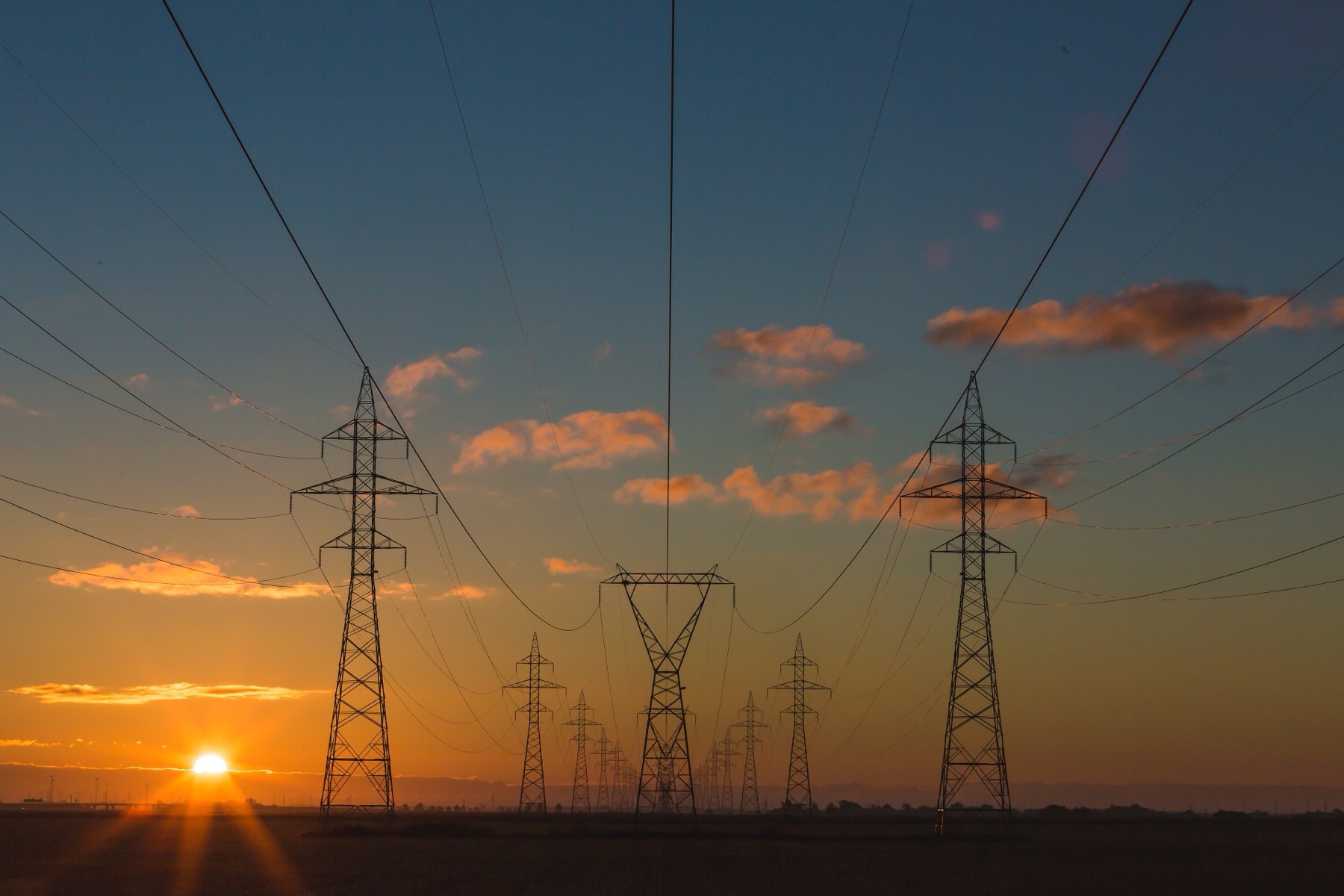
A high-voltage corridor at dusk. The Al Jouf line runs 279 towers across roughly 107 kilometres of the Tabarjal area — and above the conductors, a second network.
Illustrative image. This photograph is not of the Al Jouf line and was not taken in Saudi Arabia. It shows a high-voltage transmission corridor of the general type described here.
When something goes wrong on a high-voltage transmission line, distance becomes a problem.
A fault may occur dozens of kilometres from the nearest substation. Operators need to know where it happened, protection systems must decide which section to isolate, and circuit breakers at different ends of the line may need to respond almost immediately.
The electricity network cannot wait for a telephone call.
It needs its own communication system.
That system is part of the Al Jouf 380 kV double-circuit transmission line, a 107-kilometre project delivered by Samaya Group Company Ltd. for Saudi Arabia's Ministry of Energy. The line crosses the Tabarjal area on 279 steel towers, carrying two high-voltage circuits through the Al Jouf Region.
The most obvious parts of the project are the towers and conductors. The less obvious part runs above them: an optical ground wire containing fibre-optic strands.
It is the second network built into the transmission line.
The wire above the wires
Look at a transmission tower and the thick conductors suspended from its crossarms draw most of the attention. Those are the cables carrying electrical power.
Higher up, near the top of the structure, is another cable.
Optical ground wire — usually shortened to OPGW — occupies the position traditionally used by a shield or earthwire. Its outer metallic layers help protect the transmission line from direct lightning strikes. At its centre are optical fibres capable of carrying information over long distances.
This combination allows one cable to perform two very different jobs.
It protects the electrical line physically while providing a high-speed communication route for the network operating around it.
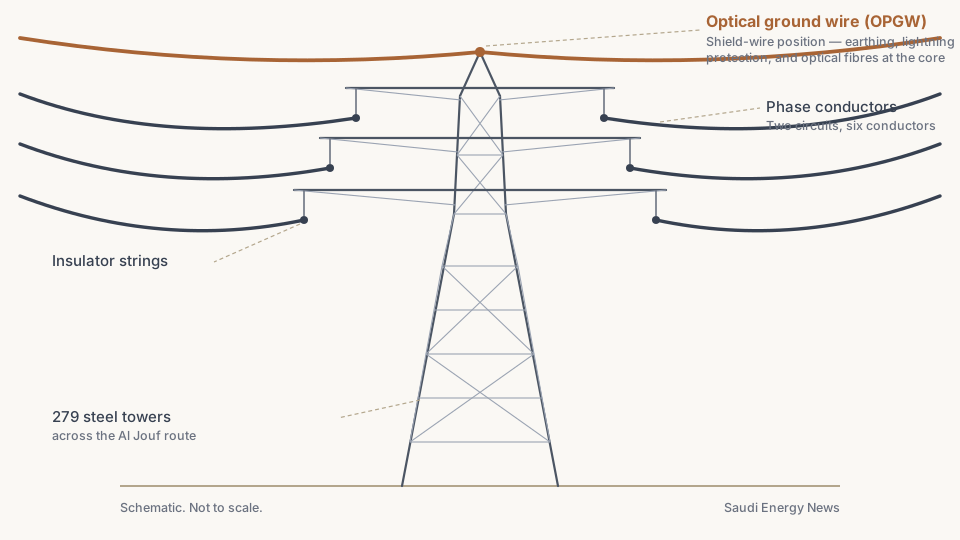
On a double-circuit tower the phase conductors hang from the crossarms. The optical ground wire occupies the shield-wire position above them, where it intercepts lightning and carries the fibre.
Saudi Energy News diagram
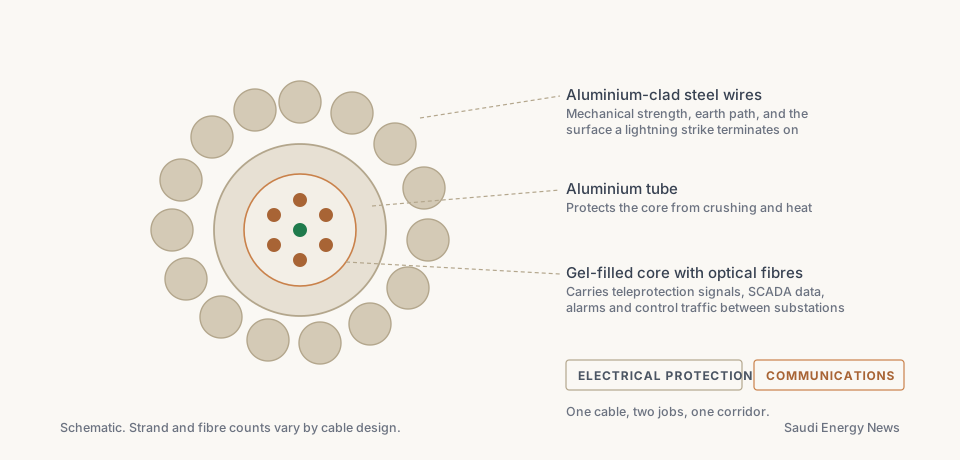
One cable, two jobs. The metallic layers do the earthing and lightning work; the fibres in the core carry the information.
Saudi Energy News diagram
For the Al Jouf transmission project, the OPGW was installed as part of the wider fibre, protection, control and communication system. That meant the completed corridor was not simply capable of moving electricity between grid points. It could also exchange the information required to manage that movement.
The scale of that second network is visible in the project's bill of quantities. The scope covers 110.21 kilometres of OPGW supply, and the same 110.21 kilometres of OPGW installation and sagging, along a route of approximately 107 kilometres.
The three-kilometre difference is not an error. A conductor strung between towers does not travel in a straight line — it sags under its own weight, and it needs slack where sections are joined and where the cable is brought down at each end. The fibre network is measurably longer than the corridor it follows.
Why a transmission line needs to communicate
Electricity systems are expected to operate continuously, but they are not free from faults.
Lightning, damaged equipment, insulation failure or contact with an external object can create abnormal electrical conditions. When that happens, the affected part of the system must be identified and isolated quickly.
Protection relays measure current, voltage and other electrical behaviour. If those measurements indicate a fault, the relays determine which circuit breakers should open.
On a long transmission line, protection devices at opposite ends may need to compare information before making that decision.
The fibre inside the OPGW gives them a dedicated path.
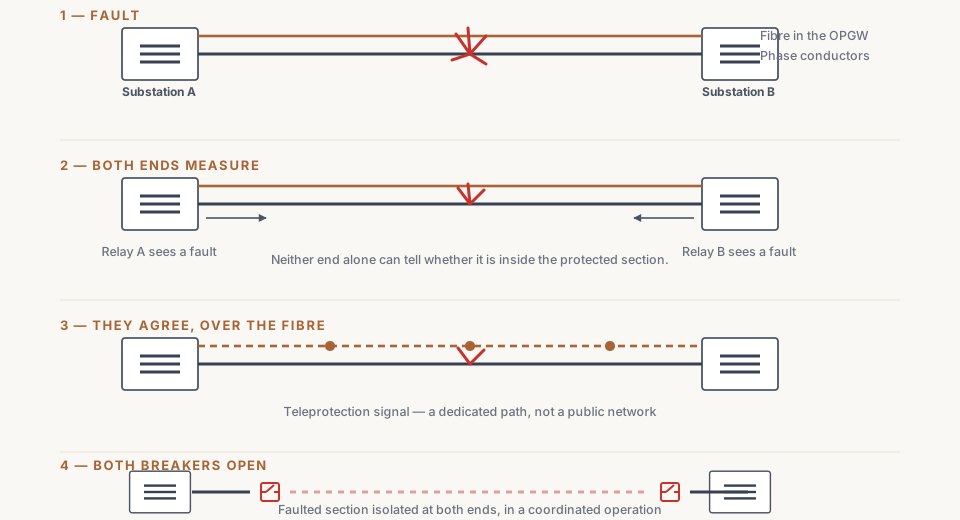
Protection at one end of a long line cannot tell on its own whether a fault is inside or outside the protected section. The fibre is how the two ends agree before they act.
Saudi Energy News diagram
Teleprotection signals can move between substations without relying on a public communications network. One end of the line can inform the other that a fault has been detected, allowing both ends to isolate the affected circuit in a coordinated manner.
This speed matters.
The longer fault current remains on the system, the greater the stress placed on conductors, transformers, switchgear and other connected equipment. Fast isolation helps limit damage and reduces the portion of the network affected by the event.
Two circuits, one shared corridor
The Al Jouf 380 kV transmission line carries two electrical circuits on the same tower route.
A double-circuit design allows more transmission capacity to be installed within one corridor. It can also give operators additional flexibility when one circuit is unavailable for maintenance or because of a network condition.
The two circuits remain electrically separate, but they form part of the same physical project. Their conductors, insulators, towers, earthing systems and communication links must all be coordinated.
That creates a large amount of information for operators to manage.
They need to know whether equipment is energised, whether protection systems are healthy, whether breakers are open or closed and whether conditions along the line remain within operating limits.
The communication system allows those details to move alongside the electricity itself.
From field equipment to the control system
Fibre alone does not make a transmission line intelligent.
It becomes useful when connected to the protection, telecommunications and control equipment at each end of the route. The Al Jouf scope includes two sets of terminal telecommunications equipment and two sets of SCADA and teleprotection integration — one at each end of the line, which is what turns a length of installed fibre into a working link between two grid facilities.
The information travelling through the Al Jouf line may include:
- protection commands;
- equipment status;
- alarms;
- operational measurements;
- fault information;
- control data;
- communication between substations and grid-management systems.
SCADA — Supervisory Control and Data Acquisition — brings much of this information into an operating environment where authorised personnel can monitor the system.
A breaker changing position can be reported.
An abnormal condition can generate an alarm.
Protection equipment can record what happened during a fault.
Operators can then understand the condition of the line without physically travelling across its 107-kilometre route.
That visibility is particularly important for infrastructure distributed across hundreds of tower positions. The steel structures may be spread across the landscape, but their operating condition must be presented as one coherent system.
Why ordinary communications are not enough
A public mobile or internet connection may be acceptable for many everyday activities. Protection of a 380 kV transmission line demands something more controlled.
The network must remain available when the electricity system is under stress. Signals must arrive quickly and predictably. Communication equipment also has to work with protection devices designed for specialised grid operations.
A dedicated fibre route gives the transmission operator greater control over that communication path.
Because the OPGW follows the same physical corridor as the power line, it connects the relevant grid locations directly. It does not need a separate trench to be excavated across the full distance, and it remains associated with the infrastructure it supports.
Installing it, however, still requires precision.
The cable must be strung and tensioned correctly. Fibre sections have to be spliced. Optical tests must confirm that signals can travel through the completed route without unacceptable loss or hidden defects.
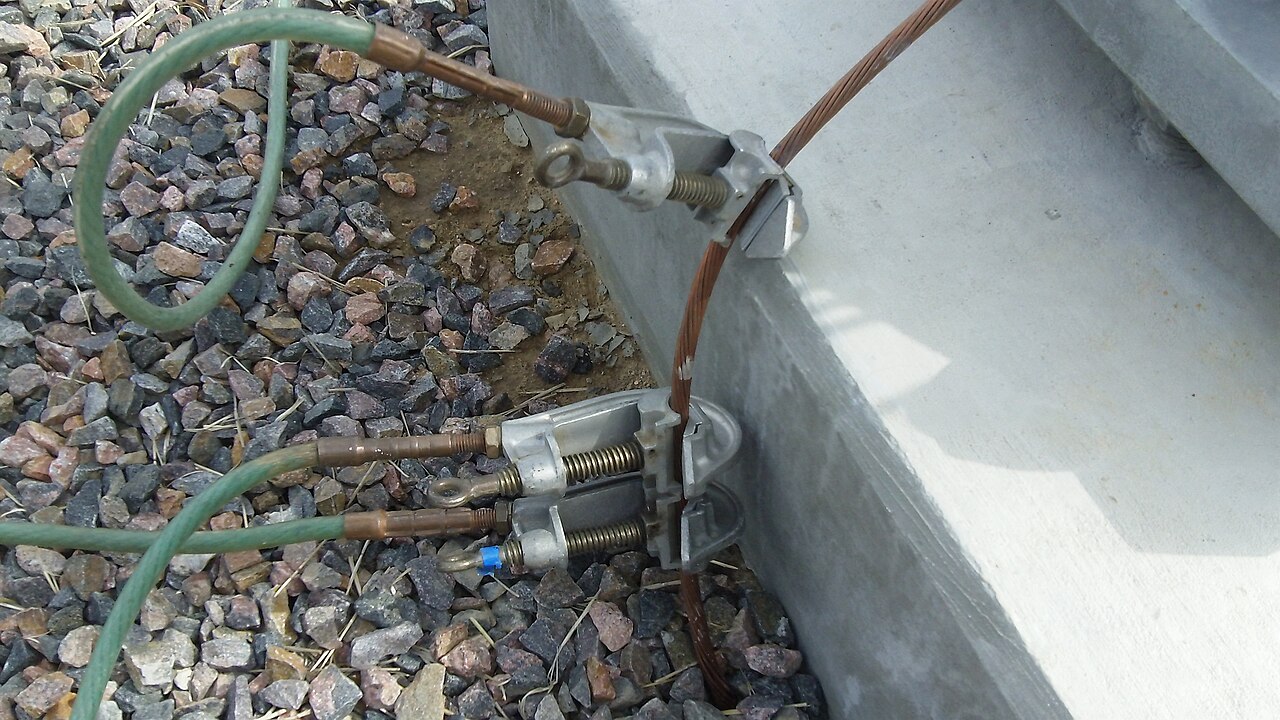
A temporary grounding point clamped to an optical ground wire during work on a line. The stranded metallic outer layers that do the earthing and lightning work are visible around the fibre core.
Illustrative image. This photograph is not of the Al Jouf line and was not taken in Saudi Arabia. It shows OPGW hardware of the general type described here.
Credit: OLC Fiber, Lakewood, Colorado · CC BY 2.0 ↗ · source
The Al Jouf scope names that testing explicitly: fibre splicing, OTDR and acceptance testing across the full 110.21 kilometres. An optical time-domain reflectometer sends a pulse of light down the fibre and measures what comes back, which is how a splice with too much loss — or a break in a cable that looks perfectly healthy from the ground — is found and located before the line is handed over.
The communication network is therefore constructed, tested and commissioned with the same seriousness as the electrical system around it.
The role of the 279 towers
The 279 towers of the Al Jouf project do more than hold the phase conductors above the ground.
They also carry the OPGW from one end of the route to the other.
At selected locations, fibre joint boxes allow separate cable sections to be connected. The project scope lists 28 OPGW joint boxes along the route, and two fibre termination panels — one at each end, where the fibre finally meets the telecommunications and protection equipment associated with the line.
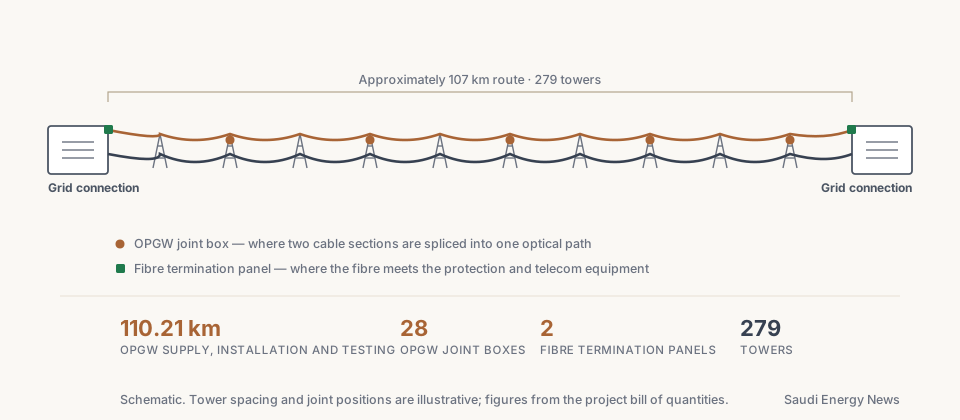
The corridor carries two forms of continuity at once — an electrical one and a digital one. Figures from the project's bill of quantities.
Saudi Energy News diagram
This means every tower is part of two forms of continuity.
The first is electrical: maintaining the required position and clearance of the high-voltage conductors.
The second is digital: supporting an uninterrupted fibre path across the transmission corridor.
Damage to either network can affect the operation of the line, which is why installation, earthing, lightning protection and communication testing all form part of one project rather than separate afterthoughts.
Samaya Group's Al Jouf project
Samaya Group Company Ltd. delivered the engineering, procurement and construction of the Al Jouf 380 kV double-circuit overhead transmission line between 2021 and 2023, under a contract valued at SAR 201,612,900.
The project combined several disciplines across the Tabarjal corridor:
- route and topographical engineering;
- civil and foundation construction;
- tower supply and erection;
- high-voltage conductor installation;
- OPGW and fibre-optic works;
- protection and control systems;
- telecommunications;
- testing and grid integration.
The fibre system could not be treated as a final accessory added after the electrical work.
Its routing depended on the towers. Its testing depended on completed splices and terminations. Its operational purpose depended on successful integration with the protection and control systems at the connected grid facilities.
The line became complete only when electricity and information could both move across it.
Seeing the Al Jouf line differently
From the ground, the Al Jouf project appears to be a familiar piece of transmission infrastructure: steel towers carrying high-voltage conductors across a long route.
That view is accurate, but incomplete.
Running above the conductors is a communication network that allows equipment separated by more than 100 kilometres to behave as parts of the same system.
It helps protection devices coordinate during faults. It gives operators visibility over the line. It carries the control and operational information required to manage a modern grid connection.
The towers mark the route of the electricity.
The fibre explains how the network knows what is happening along it.
Search
- How long is the fibre-optic run on the Al Jouf 380 kV line?
- The project's bill of quantities covers 110.21 kilometres of optical ground wire supply and 110.21 kilometres of OPGW installation and sagging, along a route of approximately 107 kilometres. The optical ground wire is longer than the route because the cable sags between towers and needs slack at joints and terminations.
- How many fibre joint boxes are on the Al Jouf transmission line?
- Twenty-eight. Optical ground wire is delivered and strung in sections, and a joint box is where two sections are spliced into a continuous optical path. The route also has two fibre termination panels, one at each end, where the fibre meets the telecommunications and protection equipment.
- What is optical ground wire, and why is it used on transmission lines?
- Optical ground wire, usually shortened to OPGW, is a cable that occupies the shield-wire position at the top of a transmission tower. Its outer metallic layers do the job a conventional earthwire does — intercepting direct lightning strikes and providing an earth path — while optical fibres at its core carry communications. One cable performs both functions, and because it follows the same corridor as the power line it connects exactly the grid locations that need to talk to each other.
- Why does a high-voltage transmission line need its own communication network?
- When a fault occurs on a long line, protection relays at opposite ends may need to compare measurements before deciding which circuit breakers should open. A dedicated fibre path lets teleprotection signals move between substations quickly and predictably, without depending on a public network. Fast, coordinated isolation limits the stress placed on conductors, transformers and switchgear, and reduces how much of the network is affected.
- Who built the Al Jouf 380 kV transmission line?
- Samaya Group Company Ltd. delivered the engineering, procurement and construction of the line for the Ministry of Energy of Saudi Arabia, between August 2021 and September 2023. The contract value stated in the project documentation is SAR 201,612,900.
Sources
Ministry of Energy letter of award, ref MOE/LOA/2021/0801, 1 August 2021
Project documentation provided by Samaya Group Company Ltd. Not independently published by the ministry.
Ministry of Energy project completion confirmation, ref MOE/TRANSMISSION/2023/0930, 30 September 2023, with appendix 1 covering the scope of work and bill of quantities
Project documentation provided by Samaya Group Company Ltd. The quantities cited in this article — OPGW length, joint boxes, termination panels, testing and integration scope — are read from the attached bill of quantities.
Sourcing note
The quantities and dates in this article are taken from project documentation provided by Samaya Group Company Ltd.: a Ministry of Energy letter of award dated 1 August 2021, and a completion confirmation dated 30 September 2023 with the scope of work and bill of quantities attached. Saudi Energy News has not independently verified these documents against a ministry publication, and the documents name the Ministry of Energy rather than the National Grid SA as the contracting party. Figures are reported as they appear in that documentation and attributed accordingly.
Organisations in this story
Related project
Power & Utilities · Al Jouf
Top story